
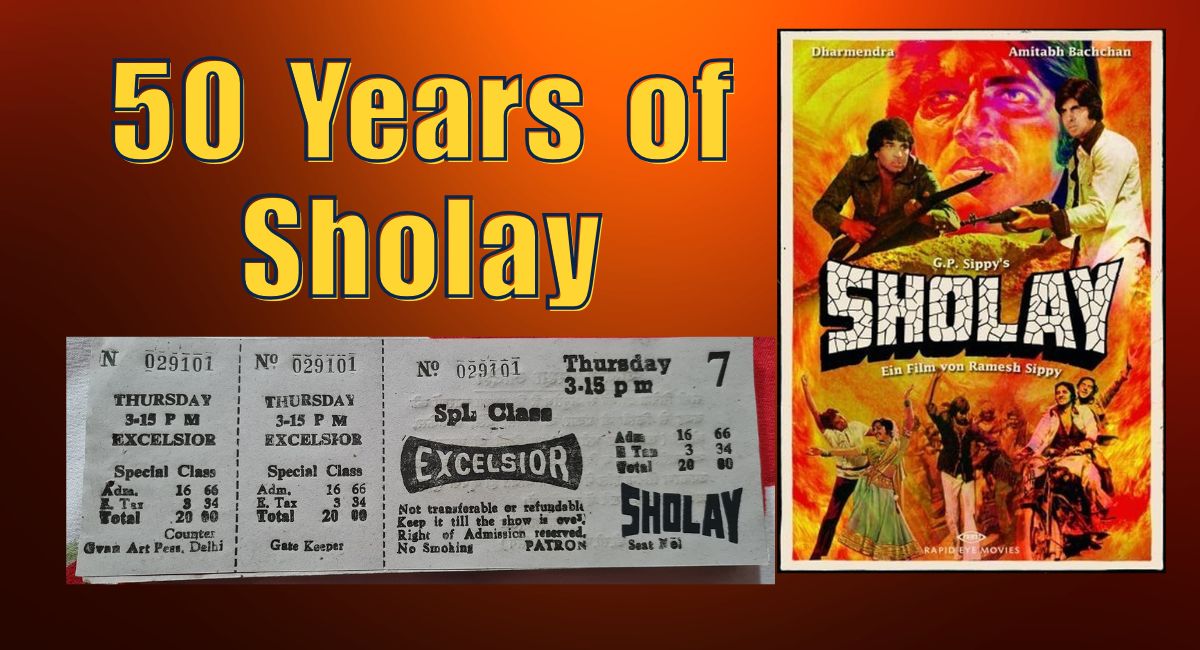
Sholay at 50: A Cinematic Milestone in Bollywood History
The history of Indian cinema remains incomplete without the mention of Sholay. On 15th August 1975, Bollywood witnessed a landmark moment with the release of Sholay, a film that went on to become one of the most iconic and successful productions in the history of the Hindi film industry. As of 15th August 2025, Sholay celebrates its 50th anniversary.
Sholay was the dream of the father-son duo, G. P. Sippy and Ramesh Sippy, who commissioned renowned screenwriters Salim–Javed (Salim Khan and Javed Akhtar) to develop a four-line concept. This idea, which the writers narrated to the Sippy’s, drew inspiration from Akira Kurosawa’s 1954 classic, Seven Samurai.
One of the primary contributors to Sholay’s enduring success was its compelling story and screenplay
crafted by Salim–Javed. Every character—from Jai and Veeru to Gabbar Singh, Thakur, Basanti, the
Jailor, Sambha, and even the horse Dhanno—remains etched in the public memory even after five
decades. The film’s dialogues became cultural touchstones, with lines like “Kitne aadmi the?” continuing to resonate with audiences across generations.
Sholay was not only a box office phenomenon but also a landmark in Indian cinematic history for introducing numerous firsts. It was the first Bollywood film to be shot in 70 mm format with stereophonic sound, setting a new standard in audio-visual presentation.
The film boasted a multi-starrer cast, including Amitabh Bachchan, Dharmendra, Hema Malini, Jaya Bhaduri, Sanjeev Kumar, Amjad Khan, Asrani, Jagdeep, Sachin, A. K. Hangal, Keshto Mukherjee, Viju Khote, Satyen Kappu, Leela Mishra, and Mac Mohan—a casting coup even by 1975 standards.
The casting process saw considerable changes. Initially, Danny Denzongpa was signed to play Gabbar Singh. However, due to scheduling conflicts with his prior commitment to Dharmatma, he had to withdraw. The role was eventually offered to a then-unknown Amjad Khan, whose performance as Gabbar became legendary. It is also believed that Pran was the original choice for Thakur Baldev Singh, but when that did not materialize, Sanjeev Kumar was cast in the role—despite being relatively young for the character’s age. Shatrughan Sinha was considered for the role of Jai, but Amitabh Bachchan—who was not yet a major star—convinced the Sippy’s, through Salim–Javed, to cast him.

Producer G. P. Sippy spared no effort in realizing his son’s vision. The film was produced on a then- unprecedented budget of ₹30 million. The set of Ramgarh, constructed in Ramanagaram near Bengaluru, was among the largest outdoor sets of the time, resembling a small township housing both cast and crew.
The film’s action sequences were elaborately choreographed, with the famous train robbery sequence taking seven weeks to shoot. Notably, director Ramesh Sippy had to reshoot the climax: the original ending showed Thakur killing Gabbar, but the censors deemed it excessively violent. As a result, the ending was altered.
Despite its eventual legendary status, Sholay was initially panned by critics and underperformed at the box office during its first two weeks. So disheartened was Ramesh Sippy by the reception that he considered reshooting the climax in which Jai survives. However, strong word-of-mouth propelled the film’s popularity from the third week onward. Sholay went on to celebrate golden jubilees in 60 theatres and silver jubilees in 100 theatres across India. At Mumbai’s Minerva Theatre, the film ran for five consecutive years—a record later surpassed only by Dilwale Dulhania Le Jayenge.
Even 50 years later, Sholay remains a cultural phenomenon. Its 3D re-release on 3rd January 2014 was met with enthusiasm, proving its timeless appeal.
Sholay will forever be remembered as a landmark film that redefined Bollywood, captivating audiences across generations.